Advantages And Disadvantages Of Lace
Aug 16, 2021
1. Chemical fiber lace is a general term for the most common type of lace fabrics, mainly made of nylon and spandex. Its texture is generally thin and hard, and it may feel a bit sticky if it touches the skin directly. However, the advantages of chemical fiber lace are that it is cheap, has many patterns, many colors, and is strong and not easy to break. The shortcomings of chemical fiber lace are that it does not feel good, it can not be ironed at high temperature, it is basically inelastic, and it cannot be worn as a close-fitting garment. And generally speaking, due to the cost of chemical fiber lace, it is often used in cheap clothing, so it will give people a "relatively cheap" feeling.
2. Cotton lace is generally a kind of lace made by embroidering lace on cotton lining cloth with cotton thread, and then cutting off the hollow part of the cotton cloth. Cotton lace is also a relatively common type, which can be seen on many clothes, and its elasticity is basically the same as that of cotton. The advantage of cotton lace is that it is cheap, not easy to break, can be ironed at high temperature, and feels good. However, the disadvantage of cotton lace is that it is easy to wrinkle, has less shape, and is basically only white. Generally speaking, if you are considering cost and you are unwilling to use cheap chemical fiber lace, cotton lace is a good alternative.
3. Cotton lace, as the name suggests, is lace woven with cotton thread. Because cotton lace is all woven with cotton thread, it is generally thicker and feels rougher. The advantages and disadvantages of cotton lace are similar to cotton lace. The shape of cotton lace is a bit more than that of cotton lace, and the cost is slightly more expensive, and it is not easy to wrinkle, but because it is thicker, it is not easy to fold and bend. Generally speaking, cotton lace is usually used in some smaller laces in clothing, which is not very noticeable.
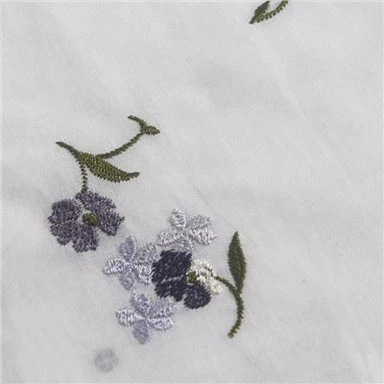
4. Embroidering lace is to embroider the lace shape with cotton, polyester and the like on a layer of gauze, and then cut off the outline. Because the interlining is gauze, the hand feel will change according to the hardness of the gauze, but generally speaking A softer embroidered lace made of softer gauze will be better. Compared with the above three, the advantages of embroidered lace are soft and smooth, not easy to wrinkle, foldable, and better elasticity. The disadvantage of embroidered lace is that it cannot be ironed at high temperature, has less shape, and is easy to tear. Generally speaking, clothing with high requirements for softness and material will basically use embroidered lace, such as skirt lining and underwear.
5. Water-soluble lace uses polyester thread or viscose filament to weave the lace pattern on a piece of backing paper. After completion, use higher temperature water to dissolve the backing paper, leaving only the lace body, as the name water-soluble lace. Since water-soluble lace has more needles than the above-mentioned laces, the cost of water-soluble lace is also more expensive. The advantages of water-soluble lace are that it feels very good, soft and smooth, slightly elastic, shiny, three-dimensional, and has many styling patterns. The disadvantage of water-soluble lace is that it is relatively expensive, relatively thick, not easy to fold, and cannot be ironed at high temperature. Generally speaking, water-soluble lace is basically used for clothing with better workmanship and material, and the price of water-soluble lace with good workmanship may reach tens or even hundreds of dollars per meter.