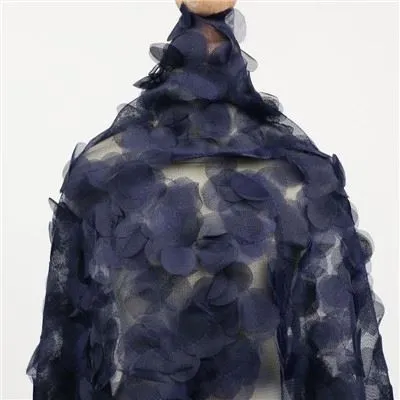
Lace, the darling of the fashion world! But there are so many types, what should I do if I can’t tell the difference?
Mar 18, 2023
Lace, the darling of the fashion world! But there are so many types, what should I do if I can’t tell the difference?
lace
Sometimes, it is a little decoration on the hem for a more elegant skirt shape
Sometimes it is an extension of the cuff with a more elegant silhouette
Sometimes, it appears on the side of the neckline, emphasizing the charming shoulder and neck line...
As an embellishment of women's clothing, lace has been interpreting the overlapping styles of elegance, delicacy, sexiness and purity in the fashion industry.
The original fabric of lace is composed of pattern and interlining, and is generally made of silk, cotton and chemical fiber blends. The higher the silk content, the more precious the lace fabric is, because its luster is the most comfortable and natural, and it is also the most fragile. This kind of fabric should be waterproof, anti-static, anti-aging, anti-alkaline corrosion... Sometimes, it needs to be taken care of like love.
But there are many types of lace.
Many people are not very familiar with some of its characteristics,
Then the editor will come to share with you some popular science today.
1. Elastic lace fabrics (nylon ammonia, polyester ammonia, nylon cotton ammonia, etc.)
Elastic lace is mainly composed of nylon, so it can also be identified by the burning property of nylon.
Because nylon is not a natural fiber, it is chemically synthesized, so if you put the flame close to the lace, it will shrink and melt very quickly, and it will burn immediately when it shrinks to a certain extent, and the speed is also very fast.
2. Non-elastic lace fabric (full nylon, polyester, nylon, polyester, cotton, etc.)
There are many types of non-stretch lace fabrics, which can generally be divided into all polyester, all nylon, nylon cotton, polyester cotton, and all cotton. Among them, all polyester, all nylon, and all cotton are generally dyed as monochrome, and nylon is generally dyed in one color. Cotton and polyester cotton can be dyed in two colors.
Lace is generally mixed with a variety of textile yarns, ranging from 3 types to more than 10 types. The unique weaving method can form endless patterns.
polyester
Generally, polyester lace feels hard. It's easy to tell when you get started.
Nylon or Nylon+Spandex
Judging from the feel, nylon is much softer than polyester and has a better texture. Plus spandex has greater elasticity and feels smoother.
Cotton (nylon/polyester/cotton)
It is the fastest and most accurate way to distinguish whether the fabric is cotton or chemical fiber.
Note: Of course, most lace ingredients raw material prices:
(Low) Polyester < Spandex < Nylon < Cotton (High)
Bone Lace
Thick patterned piping lends a rich texture that feels soft like fresh cotton with just a touch of spring. It can show mature and sweet feminine demeanor, and the gorgeousness it brings is low-key and rich.
embroidery lace
The lace patterns are all embroidered patterns. Through the texture and color of the embroidery thread, lace can also have the Chinese charm of ink painting.
Embossed lace
The lace fabric itself has multi-layer superimposed three-dimensional pattern graphics, rather than post-production. Such three-dimensional fabrics are very sophisticated in craftsmanship, and the price is more than a thousand yuan per foot.
french lash lace
Eyelash lace not only has delicate eyelash edges, but also has a mesh pattern as thin as a cicada's wing.
Impossible to wash, the Cicada Wing is so fragile that any cleaning would be devastating to it. The orthodox "eyelashes" texture, if you look carefully, you will find that it is in strands, a bit like the cylindrical structure of cotton thread, rather than the tapered shape of chemical fiber.
elastic lace
Blended with elastic fiber, it is most suitable for reflecting the graceful figure of women.
Water soluble lace
Water-soluble lace is to use polyester thread or viscose filament to weave the lace pattern on a piece of backing paper. After the completion, use higher temperature water to dissolve the backing paper, leaving only the lace body, as the name is water-soluble lace. Water-soluble lace has more needles and higher cost.
crochet lace
Crochet the lace in an open-hole pattern. More famous such as Irish hand-crocheted lace.
embroidered lace
The lace is drawn and knotted on a complete cloth, and the through-hole pattern is made by weaving the remaining yarn after drawing part of the warp or weft yarn of the base fabric.
We can judge the quality of lace by the uniformity of color.
Then there is the firmness of the fiber. Whether it is firm or not directly affects the fineness of the lace workmanship, and is the key to maintaining no breakage. You can judge the quality of the lace by carefully looking for the tightness of the thread ends.
Grade division:
Upscale: The Rolls Royce of lace is Levi's lace.
The real French Nuoyang lace is the oldest and most complicated and delicate lace in the world; high-grade handmade lace requires manual operation of equipment, ancient weaving, and pure manual processing. The process is extremely complicated. The production cycle is long and the output is low, and it is mostly supplied to international first-line big names and luxury brands; those worn by celebrities on the red carpet are basically Levi's.
Mid-range computer lace (lace commonly used by first- and second-tier brands):
It is easy to snag; the sense of three-dimensionality, layering, and permeability are obviously not as good as Levi's lace. The process is relatively simple, and the thread is relatively economical; the structure is generally firm, and the color fastness is medium; better computer lace fabrics will start to pill and deform after wearing it for less than 3 months, and slightly inferior lace tends to become loose. Spandex yarn runs out, loses elasticity, and feels softer. The lace mesh structure is much sparser than that of Levi's.
Ordinary lace:
Soft and loose, average elasticity, no three-dimensional effect, unclear patterns, and opaque lace. Basically, after one or two washes, the spandex filaments start to come out.