What is Beaded Lace Fabrics? What are Leavers Lace and Woven Lace?
Sep 28, 2022
1. Leavers Lace
The Leavers lace production process is the oldest. It is a representative of classic and noble lace. It is a real Calais lace. For hundreds of years, it has been mainly produced by hand-operated instruments, and later replaced by some machines imitating manual procedures.
Leavers lace production requires workers with high technical quality and experience. The number of people participating in the production is about 5 times more than the number of people producing Raschel lace. The pattern design process is cumbersome. For example, the yarn tension must maintain consistency and continuity, which requires a high level of expertise and skills.
(1) Features of Leavers Lace
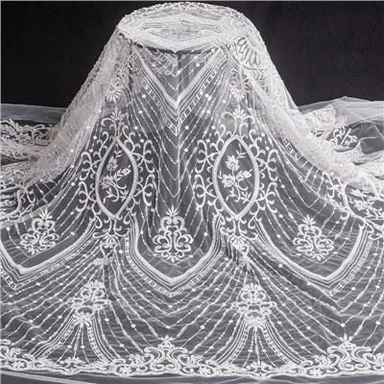
The appearance of Leavers lace can show a good sense of three-dimensionality and fineness. Leavers lace has fine patterns and clear edges. Compared with Raschel lace, Leavers lace is softer. Because of its high technical difficulty and the gorgeous elegance displayed by the product is unmatched by other laces, Leavers lace has the reputation of "the queen of lace".
(2) Materials of Leavers Lace
There are many types of thread that can be used for Leavers lace. The most commonly used are nylon lace, polyester lace, cotton lace, spandex, rayon and so on. However, due to the machine structure and production requirements, no matter which kind of thread must be twisted, at least 300 twists/meter can be used. The thickness of the line is mainly 30, 12O0D.
(3)Processing of Leavers Lace
The processing of Leavers Lace includes manufacturing, embryo formation, initial inspection, repair, cleaning, dyeing, shaping, cutting, final inspection, packaging until leaving the factory.
2.Woven Lace
Woven lace refers to warp knitted lace, namely raschel lace, including traditional raschel lace, electronic jacquard lace, and electronic pressed yarn raschel lace.
The Raschel lace is named after the famous French actress "Raschel" in the 19th century. At that time, the warp knitted scarf she wore was favored by people. Since then, her name has become synonymous with warp knitted lace.
Rascheldo lace is produced by a bar warp knitting machine, with a maximum of 78 bars. The more bars, the larger the design space. When the pattern is produced, the mechanical control uses the hook thread principle, which is obtained by the movement of the chain plate, and can use more than 10,000 pattern threads at most. Raschel lace machine adopts more advanced computer control. The lace we use now is generally woven.
The woven lace is interwoven by the warp and weft controlled by the jacquard mechanism. Multiple strips can be woven at the same time or separated after weaving individually. The width of the lace generally ranges from 0.3 cm to 17 cm.
Electronic Jacquard Lace uses electronically controlled Raschel production equipment. Its jacquard device makes the lace bottom net change diversified, such as plain weave, twill weave, satin weave, honeycomb, small pattern and other vivid and rich patterns.
The advancement of lace production technology not only expands the space for pattern design, but also shortens the distance between artistic design and actual production. The working principle of the machine for producing electronic raschel lace is the same as that of the machine for producing electronic jacquard lace, except that it has an additional pressure plate. The lace produced by the electronic raschel machine has the effect of embroidery lace. It is characterized by a strong three-dimensional sense of unevenness. But limited by the machine, the pattern is relatively flat. It does not have the three-dimensional effect of the riba lace, but it is the closest to the Leves lace.
In addition, it has high production efficiency and requires a wider range of raw materials than Liba lace, which has become a powerful factor in the growing popularity of Raschel lace.